
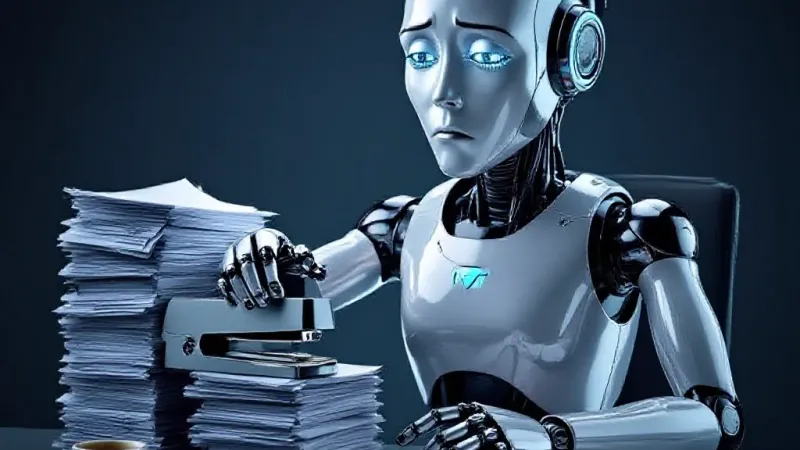
NEW YORK — Financial markets are reportedly entering a new phase of collective anxiety as a growing number of fund managers are beginning to suspect that the multi-trillion-dollar Artificial Intelligence boom might, in fact, just be a sophisticated and exorbitantly priced rebranding of existing technology, primarily staffed by perpetually caffeinated interns. The shift away from high-growth tech stocks into traditionally safer bonds signals a chilling realization: the emperor's new algorithms might be wearing no clothes.
"We poured billions into 'disruptive neural networks' and 'transformative large language models,' and for what?" confessed one anonymous portfolio manager from a major Manhattan hedge fund, speaking on condition of anonymity to avoid immediate termination. "My 'AI' is great at summarizing my emails and generating corporate platitudes. So is my new assistant, who costs significantly less than our annual NVIDIA bill and doesn't require a dedicated server farm the size of Delaware." The manager paused, rubbing his temples. "I think the AI just learned how to gaslight us into thinking it was working."
Analysts at the newly formed Institute for Aspirational Proximity Studies (IAPS) issued a grim report today, revealing that over 85% of corporate "AI solutions" were found to be either: (a) a complex series of if/then statements, (b) a highly trained data entry clerk, or (c) a chatbot that consistently recommends 'clearing your cache' for any problem. The report, titled "The Emperor's Silicon Drip," concluded that the only measurable "productivity gain" from AI was an exponential increase in pitch decks *about* AI.
"The core function of most AI initiatives, it turns out, was to convince more investors to invest in more AI initiatives," explained Dr. Evelyn Thorne, head of 'Recursive Value Creation' at IAPS. "It's an elegant, self-sustaining ecosystem where the primary output is the next funding round. We've essentially digitized the concept of 'fake it till you make it,' then pumped trillions into scaling it globally."
The sudden bout of investor sobriety has led to widespread panic across the tech landscape, as companies are now being asked to demonstrate actual, quantifiable value beyond vague promises of future disruption. "We're suddenly facing questions like, 'Where's the ROI on that sentient toaster that only burns bread into pictures of Jeff Bezos?'" lamented one startup founder, whose Series C round had just collapsed. "It feels incredibly unfair to be judged on real-world utility after two years of celebrating pure potential."
Ultimately, the market correction suggests that while AI was busy generating hypothetical futures, it forgot to generate actual profits. The vast sums funneled into these "transformative" technologies seem to have successfully optimized one thing above all else: the transfer of wealth from those who hoped for a revolution to those who sold them the picks and shovels for one that never quite arrived.