
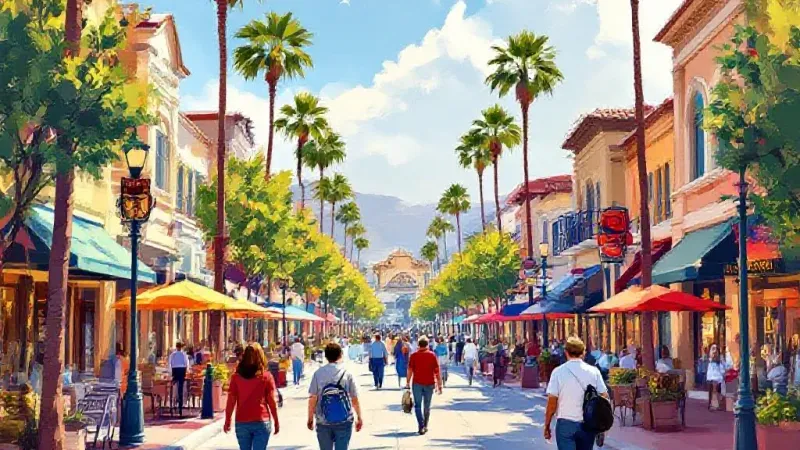
Anaheim city staff presented the "Anaheim Resort 2.0" plan during Tuesday's city council meeting, detailing a strategy to leverage public and private investment for upgrading local infrastructure and boosting the city's tourism. The plan specifically targets the Anaheim Resort district, with goals to improve infrastructure utility, facilitate movement throughout the district, and increase its interactivity.
The presentation was delivered by Deputy City Manager Ted White, alongside Planning and Building Director Heather Allen, Director of Public Works Rudy Emami, and Laura Johnson, director of urban design consultancy at Gehl Studios. They outlined four key "experience pillars" central to the resort's development plan.
The first goal focuses on creating memorable social spaces. This involves providing varied experiences in public areas, establishing multifunctional infrastructure, and ensuring visitor comfort through safe, shaded, and quiet public spaces. The second pillar aims to facilitate movement throughout the district by offering safe mobility options and designing transportation to align with the natural flow of traffic. It also seeks to increase opportunities for interactivity within the district.
The third goal is designed to stimulate private reinvestment. This objective aims to better bridge the park to public life by incentivizing increased density and variety in development and ensuring district growth aligns with an established identity. The fourth pillar seeks to broaden the district's appeal through developing a distinct district ambiance and evolving the Garden District Palette. Deputy City Manager Ted White noted that "a nearly universal appreciation and admiration for some of the key existing characteristics of the resort" was a consistent theme in the development process.
White also detailed six project ideas intended to facilitate the plan's development. These include a landmark at the intersection of Harbor Boulevard and Katella Avenue, a greenway, and an east-west connector. The proposed Harbor-Katella landmark intersection would transform one of the city's major street crossings. Ideas presented for this landmark included a suspended art piece, pedestrian-accessible art that could also provide shade, or patterned paving to create an artistic installation directly in the street.
The greenway development aims to relieve sidewalk crowding and diversify public areas by converting "passive landscaping" into functional spaces for public use, while also expanding the network and scale of public areas within the district. This greenway plan is further divided into three segments around the Harbor Boulevard and Disney Way areas. These segments address specific improvement needs, such as developing new parallel walking paths along Harbor Boulevard, south of Disney Way, and creating a "pocket park" in the northeast corner of the two streets.
The east-west connector plan is described as currently moving forward. This project is intended to simplify the visitor journey between the Anaheim Resort District and the city's Platinum Triangle, which includes key venues like Angel Stadium, Honda Center, and The Grove of Anaheim. Strategies for the connector plan prioritize high-quality waiting and arrival experiences, aiming for relaxing transit options like short service wait times, no-cost or low-cost rides, and varied seating options. White stated that the connector plan envisions end-point structures, such as the Anaheim Regional Transportation Intermodal Center, as hubs for special districts. These hubs would provide amenities like bathrooms, hydration stations, "grab and go" convenience options, and would develop a distinct brand language to differentiate the connector from other transit systems.
City staff's presentation also included an implementation framework with near-term, mid-term, and long-range development models. Near-term strategies involve developing high-impact approaches by updating policy guidelines, testing pilot programs, and creating toolkits. Mid-term development plans focus on physical improvements and the strategic implementation of proposed changes when appropriate funding and construction opportunities become available. Long-term development plans consist of transformational projects that would require further studies, partner alignment, and significant financial allocation.
During the council comment period, District 3 Councilmember Natalie Rubalcava raised concerns regarding the funding mechanisms for this extensive project. She highlighted the city's existing structural deficit, noting that she recognized the deficit was generated by past investment in the resort. Councilmember Rubalcava suggested that a city council member should work with Disney to develop fundraising strategies for the plan. She emphasized that funding for Resort 2.0 "should not be at the expense of residents."